For most engineering teams and facility owners, selecting a wastewater treatment plant manufacturer is not something they do very often. That is exactly why it is easy to make the wrong choice. Choosing the wrong supplier can lead to compliance issues, costly retrofits, premature equipment replacement, and higher operating expenses.
Every project is different. A food processing plant, a residential township, and a manufacturing facility all generate different types of wastewater. A manufacturer that understands those differences is far more likely to recommend a treatment system that performs reliably over the long term instead of simply offering the same solution to every customer. This guide explains what to look for when choosing a Wastewater treatment plant manufacturers and how package water treatment plants fit into the decision-making process.
Why Every Manufacturer's Website Sounds the Same
High removal efficiency. Low energy consumption. Compact footprints. Almost every manufacturer makes these claims. In real, many wastewater treatment systems look similar. The actual differences become clear after commissioning, when the operating conditions aren't as previously assumed, maintenance has to be carried out, or the plant is expected to operate under actual rather than assumed conditions.
7 Signs You are Looking at One of the Best Wastewater Treatment Plant Manufacturers
When considering a quote, check every supplier using this list.
● Asks for influent data before recommending a system, not after.
● Completely designs and produces core technology, including membranes and biological media; does not rely on third-party components.
● Holds ISO 9001 and ISO 14001 certifications, along with product certifications such as CE for membrane products.
● Can supply design calculations for the process, treated water performance data or pilot study results as needed.
● Provides more than one treatment technology and recommends the right option based on your site requirements.
● Provides clear information about spare parts availability, warranty coverage, and service response times.
● If a supplier hesitates to answer any of these questions, keep asking.
In-House Manufacturing vs. Assembled Systems
This is one of the biggest differences between manufacturers, even though it isn't always obvious from a specification sheet.
Some manufacturers design and produce their own membranes, tanks, and control systems. Others source major components from different suppliers and assemble them into a finished product. While both approaches can produce a functional plant, they offer different levels of quality control, consistency, and technical support.
In-house manufacturing usually means:
● Higher level of uniformity in quality control from unit to unit.
● A single point of accountability if equipment does not perform as expected.
● Faster troubleshooting because the manufacturer understands every major component of the system.
Ask whether the membrane used in the MBR system is manufactured in-house or sourced from another supplier. The answer often tells you how much control the manufacturer has over quality and long-term support.
Certifications Worth Checking For
Not all certificates are created equal. These do:
● ISO 9001 is a documented, repeatable quality management system.
● ISO 14001 covers environmental management systems.
● CE certification for third-party verified membrane products.
● Verified test data on flux rate, rejection rate, and expected membrane lifespan, not just marketing claims.
A certificate won't start your plant. However, a manufacturer that doesn't have one, or isn't able to provide test data upon request, is a more difficult company to trust with a multi-year asset.
Matching the Technology to Your Water
There is no single best wastewater treatment technology. The right solution depends on your wastewater characteristics, available space, and discharge or water reuse requirements.
● Conventional activated sludge: conventional, well-known, requires more space.
● Extended aeration: inexpensive to operate, widely used with smaller commercial/municipal loads.
● Compact biological treatment for variable loads: MBBR (moving bed biofilm reactor), MBR (membrane bioreactor): replaces the clarifier and sand filter stages with a membrane barrier, reducing the footprint by approximately 40% to 60% and producing effluent quality suitable for reuse.
This is why experienced manufacturers ask detailed questions before recommending a plant. Wastewater flow, available space, discharge limits, and future expansion plans all influence the final design. Two sites with similar capacities may still require completely different treatment technologies. A well-planned treatment system is easier to operate, maintain, and expand as your facility's wastewater treatment requirements change over time.
What Is a Package Water Treatment Plant?
Instead of building each treatment stage on site, a packaged water treatment plant is manufactured, assembled, and tested at the factory before delivery. This reduces the amount of on-site civil work, helping projects move forward more quickly while maintaining consistent build quality.
The complete system, including the treatment units, pumps, blowers, controls, and membrane or clarification components, arrives ready for installation. Once it reaches the site, the focus is mainly on positioning the unit, connecting utilities, and completing commissioning.
Why US Buyers Keep Choosing Package Plants
Many industrial facilities choose package plants because they reduce installation time without compromising factory-built quality.
● Faster installation: Weeks instead of months of civil construction.
● Reduced civil cost: Minimized excavation, concrete, and construction risk
● Consistent factory-built quality: All modules are manufactured on the same production line (useful for chains, developers, and roll-outs).
● Container or skid-mounted units: Tight urban lots, remote job sites, or locations where large-scale construction is not practical
● Easy to expand: Additional capacity can be added to the plant without redesigning the entire plant
Package Plant vs. Conventional Build: Quick Comparison
|
Factor |
Conventional On-Site Build |
Package Water Treatment Plant |
|
Construction time |
Months of civil work |
Weeks, mostly site prep and hookups |
|
Civil cost
|
Higher, multiple concrete structures |
Lower, factory-assembled unit |
|
Quality consistency |
Varies by contractor |
Uniform, same factory build |
|
Footprint |
Larger |
Smaller, especially with MBR |
|
Best suited for |
Large, permanent municipal sites |
Industrial sites, hotels, housing developments, remote or space-constrained locations |
|
Scalability |
Requires redesign |
Often modular and expandable |
|
Factory Testing |
Limited
|
Fully tested before shipment |
Questions Worth Asking Before You Sign for Wastewater Treatment Plant Manufacturers
Keep this list on hand for vendor calls.
● What influent data has been used to size this plant, and what is the impact if the actual flow changes?
● Do you manufacture the core technology in-house? Can you share performance test data?
● What is the normal life span of the membranes/media, and what is the replacement expense?
● What are your certifications for your manufacturing process?
● Do you have examples of work that you've done on projects comparable to mine?
● What is the warranty on it, and how quickly do you turn around issues?
● Can this be offered as a package plant, or what does the installation time frame look like?
A manufacturer who answers these questions with specifics, not just reassurances, is one worth taking seriously as a Wastewater treatment plant manufacturer.
Choosing the Right Partner
If you are purchasing a small commercial unit or large industrial plant, the manufacturer is as important as the technology. Find a partner who is knowledgeable about your water quality and adjusts the treatment method to fit your needs rather than copying and pasting a pre-made plan, has the proper certification on parts, and is available after commissioning with actual technical support.
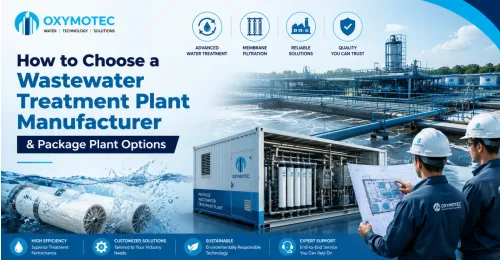
Oxymo Technology designs and manufactures compact, low-sludge MBR wastewater treatment systems customized for every site, ranging from 5 KLD to over 1,000 KLD, serving housing developments, hotels, hospitals, and industrial facilities in the United States. Reliable after-sales support is just as important as the equipment itself. Quick access to spare parts, technical assistance, and experienced service engineers can significantly reduce downtime throughout the plant's life.
Frequently Asked Questions
1. What is the difference between a wastewater treatment plant and a package water treatment plant?
A conventional plant is built on-site from separate structures for aeration, clarification, and filtration. A package plant combines those stages into one factory-built, pre-tested unit that ships ready for installation.
2. Are package plants only for small plants?
No. Package plants are available in small commercial sizes to large industrial/municipal capacity, and can be expanded or duplicated in multiple locations.
3. Is MBR always better than a conventional treatment plant?
Not always. MBR offers a smaller footprint and higher effluent quality suitable for reuse, but the right technology depends on the influent, available space, and discharge requirements. A capable manufacturer assesses this before recommending a system.
4. How long do membranes typically last?
With proper operation and maintenance, reinforced membranes commonly last 5 to 8 years, depending on water quality and usage patterns.
5. What are the factors to consider before selecting a manufacturer?
Ensure that the in-house manufacturing capabilities, certifications (ISO 9001, ISO 14001, CE), references to similar projects, warranty terms, and realistic installation time are confirmed.
6. How do I compare wastewater treatment plant manufacturers?
Compare manufacturers based on engineering expertise, certifications, in-house manufacturing capabilities, after-sales support, project references, warranty terms, and the long-term operating costs of their systems, rather than comparing only the purchase price.
Get the Right Manufacturer for Your Site
Each wastewater project is different, with various flow rates, water quality, discharge requirements, and space constraints. Our engineering team reviews your application and recommends a treatment solution for wastewater treatment plant manufacturers based on your operational needs. Call us now to discuss your project and find the right wastewater treatment system for your facility.