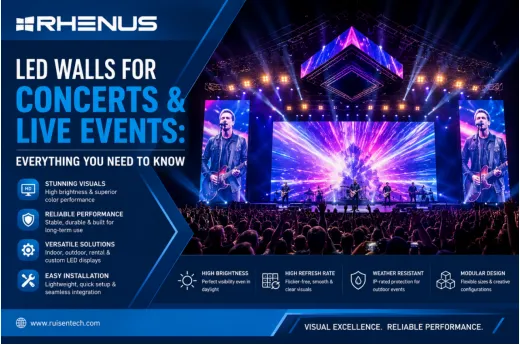
When you walk into any major concert event today, the first thing that hits you is the visuals. You see it as soon as you enter the premises before you notice the music or the crowd. Massive screens stretch from the floor to the rigging, which lights up the entire venue. You can see footage, graphics and also live camera feeds. The LED video wall for events does its work that it was built to do.
The display is not simply a background element for live events. It is part of the experience. The right LED setup can change the way people feel in that space, whether you are running a music festival with 50,000 attendees or an intimate corporate awards night. This guide explores the reasons that make LED video walls the standard choice for concerts and live events and what specs matter. It will help you choose the right setup for your show.
What Makes an LED Video Wall Different from Regular Screens?
An LED video wall is built from individual LED panels that lock together to form one continuous display surface. These walls have no visible borders between panels, so they can reach enormous sizes and perform reliably in both dark indoor venues and bright outdoor environments. These features make it different from standard projectors or LCD screens.
This combination is important for live events. A projector washes out the moment stage lighting kicks in. An LCD display has size limits and bezel lines that break the image. An LED video wall does not compromise your experience.
Why LED Video Walls Are the Standard for Live Events
Brightness That Holds Up Under Stage Lighting
Stage lighting is intense. Spotlights, wash lights, and strobes compete with whatever is on the screen. LED video walls produce brightness levels between 1,000 and 10,000 nits depending on the model. They remain vivid and legible even with full production lighting running at the same time. For comparison, projectors peak around 300 to 500 nits.
Any Size, Any Shape
The modular nature of LED panels allows the display to be built to any dimension as the production requires. The following are the common configurations for live events.
● Wide landscape screens behind the main stage.
● Flanking side screens for sightlines from the sides of the venue.
● Curved or angled screens that wrap around the performance area.
● Floor LED tiles integrated into the stage surface.
● Hanging LED panels suspended from rigging above the crowd.
Fast Setup and Breakdown
Touring productions live and die by load-in and load-out times. Rental LED panels are designed for this situation. They have lightweight frames, connect without requiring tools, and can be scaled using panels that let a crew build a large wall in a matter of hours. The panels can be swapped out individually in case of any damage during transit. There is no need to take down the whole display.
Dynamic Content in Real Time
A live event screen does not show a static image. It has to run live camera feeds, pre-rendered visuals, real-time graphics, and timed sequences. They are shown all at once across different zones of the display. LED video walls are compatible with professional video processing equipment that handles all of this simultaneously without lag or degradation. Content can be updated or switched remotely, and the panel layouts can run different content on different sections of the same wall.
Key Specs to Understand Before Choosing a Display
Although LED walls are a good idea, it does not mean every LED wall is right for every event. You need to check the numbers.
| Specification | What It Means | Recommended for Events |
| Pixel Pitch | Distance between LED clusters determines resolution at viewing distance | P2.6–P3.9 for indoor stages; P4–P6 for outdoor |
| Brightness | Measured in nits, higher means more visible in ambient light | 1,500–3,000 nits (indoor); 5,000+ nits (outdoor) |
| Refresh Rate | How many times the screen updates per second; affects camera capture | 3,840 Hz or higher to avoid banding in video footage |
| Contrast Ratio | Difference between the brightest white and darkest black | Higher is better for vivid stage visuals |
| IP Rating | Protection against dust and water is critical for outdoor events | IP65 or higher for outdoor use |
| Panel Weight | Affects rigging load limits and crew requirements | Lighter aluminium panels preferred for touring |
Common Applications Across Event Types
LED video walls are widely used for a range of live events. They may show up in the following different settings.
● Music Concerts and Festivals
The largest installations happen here. Main stage LED walls can span 20 to 40 meters wide. They run IMAG (image magnification) feeds along with pre-produced visuals synced to the performance. Festival stages use multiple independent screens across the site so the crowd at the back has the same visual experience as those at the front.
● Corporate Events and Award Ceremonies
Conference stages use narrow walls with tight pixel pitch. The configuration is important for sharp text and presentation slides. Award shows use LED creatively branded backdrops, animated transitions, and speaker name displays that merge with the event identity.
● Sporting Events
Scoreboards and perimeter displays are the obvious applications, but sports venues also use LED walls for sponsor branding. They also use it for crowd entertainment during breaks, and broadcasting replays to sections of the stadium that are far from the field.
● Theatre and Performing Arts
LED is also replacing painted backdrops in stage productions. A single wall behind the performers can change scenes instantly, such as a forest, a city, or an abstract landscape without any physical set change.
● Product Launches and Brand Activations
The display is the centrepiece for high-stakes brand moments. Product launches use large LED backdrops or creatively shaped displays to make the reveal land harder visually.
Conclusion
A good LED video wall for events becomes a part of the show. The display shapes the way the audience connects with what is happening on stage, whether it is a sold-out arena concert, a product launch, or an outdoor festival. Getting the specs right, working with an experienced supplier, and planning early are essential. These factors separate a display that disappears into the background from one that people still talk about after the event ends.
Ruishen Technology offers a full range of rental and fixed LED display solutions for live event environments. Contact the team to discuss your next project.
FAQs
1. What is the ideal pixel pitch for a concert LED wall?
A pixel pitch of P2.6 to P3.9 is a solid range for indoor concerts where the closest viewers are 5 to 8 metres from the screen. For outdoor festivals with longer viewing distances, P4 to P6 is more common and cost-effective.
2. Can LED video walls be used in the rain?
Outdoor-rated LED panels with an IP65 rating or higher are made to handle rain and dust exposure. Always confirm the IP rating before using any display in an open-air environment.
3. How is an LED video wall controlled during a live event?
LED walls connect to a video processor or controller, which receives signals from cameras, media servers, and playback systems. Operators manage the display from a production desk using professional AV software.
4. How much does an LED video wall for events cost?
Costs depend on screen size, pixel pitch, indoor vs. outdoor spec, and whether you are renting or purchasing. Rental rates for touring-grade LED panels are calculated per square metre per day. Purchasing is a better option for venues or production companies, as they have to run frequent events.
5. Can LED panels be repaired if one section fails during an event?
One of the advantages of modular LED panels is that individual tiles can be swapped out without taking down the entire display. Most touring-grade LED walls are designed for fast panel replacement because of this reason.
6. How early does an LED wall need to be installed before an event?
Crews begin load-in one to two days before the event for a large stage installation. Smaller setups for corporate events can be installed in a few hours. Always factor in time for testing, calibration, and run-throughs with the production team.
