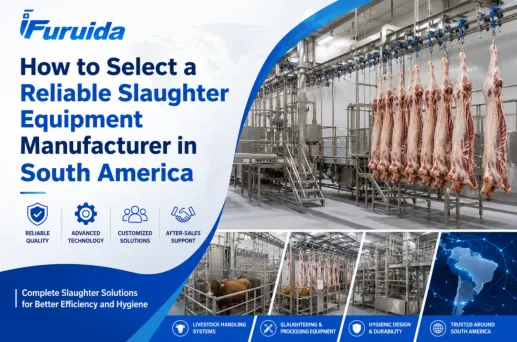
Purchasing slaughter equipment is not a small decision. Whether you are running a medium-sized processing plant in Brazil or an abattoir that is growing in Argentina, the manufacturer that you select will affect your daily output, your hygienic compliance, and your bottom line for years to come. Get it right, and the equipment runs silently in the background doing its job. Get it wrong, and you have downtime, failed inspections and parts that take weeks to get.
In recent years, South America’s poultry business has experienced substantial growth. Brazil alone processes more than 900 million birds a year and is the world’s largest chicken exporter. Argentina's nationally inspected facilities are boosting capacity to serve a growing local market. This increase has led to additional manufacturers of slaughter equipment entering the market, which means more choice, but also more risk if you do not know what to look for.
This guide takes you through the six key elements to consider when judging a slaughter equipment manufacturer for your South American company.
6 Factors To Evaluate Slaughter Equipment Manufacturer
1. Verify Certifications and Compliance with Regional Standards
The first thing to examine is whether the manufacturer’s equipment fits the regulatory requirements in your nation. Processing plants under federal inspection in Brazil need to meet MAPA (Ministério do Agricultura, Pecuária e Abastecimento) criteria. SENASA is in charge of slaughter and food safety procedures in Argentina. If your equipment does not pass inspection according to these guidelines, then it doesn’t matter how well it performs on paper.
As well as regional conformity, check for globally acknowledged certifications such as ISO 9001 for quality management and CE marking for equipment safety. With these certificates, manufacturers have their procedures audited externally, which provides a level of confidence that informal suppliers just cannot match.
2. Assess the Range of Poultry Slaughtering Equipment They Offer
A manufacturer who sells only one or two machines is hardly a stable long-term partner. As you produce more, your processing line will need to grow with it. A full producer of slaughter equipment should be able to provide all stages of the processing chain from stunning and bleeding systems to scalding machines, plucking machines, evisceration tables, pre-chilling units and cutting and packing equipment.
This is important for two reasons. First, purchasing from one manufacturer minimises integration issues. Machines built to function together on one line are more consistent than a jumble of machines from different manufacturers. Secondly, a manufacturer with a large line has more detailed engineering knowledge. They know the whole workflow, not just one station, and they exhibit that knowledge in the quality of their recommendations.
3. Look for Customisation Capability
Average conditions are catered for in standard cataloguing machines. Your processing plant is not like the others. You have a certain floor plan, a given bird population, a given power supply, and maybe unusual drainage or water pressure. A good slaughter equipment manufacturer would design to your real requirements rather than expecting you to fit your plant around an off-the-shelf product.
Ask directly if they can change the tank dimensions on a scorching machine. Can you set the plucking line for your BPH target? Do you offer OEM or private label alternatives for your business needs? Manufacturers who offer true customisation will have a technical consultation with you before starting manufacturing.
4. Check Their Export and Shipping Experience
There are many purchasers who misunderstand the logistical challenges of sourcing slaughter equipment from a source outside South America. There are import duties, customs paperwork, port processing and inland freight, all adding time and cost. This will be much smoother with a manufacturer that has established export experience as opposed to a business that considers overseas orders as an afterthought.
Look for manufacturers that ship under standard Incoterms such as FOB, CIF or CFR and that give complete export documentation, including commercial invoices, packing lists, certificates of origin and any documents required for customs clearance in your nation.
5. Evaluate After-Sales Support and Spare Parts Availability
This is where many customers learn a terrible lesson. The brochure shows amazing-looking slaughter equipment that functions well upon arrival. Six months later, the rubber finger on the plucking machine wears out, or a heating element in the scalding tank needs replacing, and suddenly you find that the manufacturer has no local representative, spare parts take four to six weeks to ship, and nobody responds to your messages outside business hours in another time zone.
A good slaughter equipment manufacturer will be transparent about what spare parts come with the unit, what the expected maintenance plan looks like, and how they support clients after delivery.
6. Request References and Review Their Project History
Any manufacturer can talk a good sales game. What you want to see is proof. Request case studies or references from processing plants similar in size to yours, preferably from your country or region. A manufacturer with real worldwide project experience will have recorded evidence, pictures or video of installed lines in operation.
Pay attention to the specifics. A manufacturer who shares their project history and any problems they solved is so much more trustworthy than one that just has a perfect highlight reel.
Conclusion
Choosing the best slaughter equipment manufacturer in South America is all about one thing: a partner who maintains accountability even after the equipment has arrived. Certifications, customising capability, export experience and after-sales assistance are not add-ons. They are the standard. So spend some time checking each one before you commit, and you will avoid the costly blunders that result from putting cheap above reliability.
If you are ready to speak to a manufacturer who has been able to implement solutions for plants in over 20 countries on your processing requirements, contact the Furuida team immediately and get a price tailored to your real capacity demands.
Frequently Asked Questions
1. What certifications should I look for in a slaughter equipment manufacturer?
Look for ISO 9001 accreditation as a baseline quality standard and CE marking on the equipment itself. For South American compliance, ensure equipment fulfils MAPA criteria in Brazil or SENASA requirements in Argentina.
2. Can I import slaughter equipment from China to South America?
Yes. Many processing factories in South America buy poultry-slaughtering equipment from manufacturers in China, especially those in Nanjing and Shandong that have export programs in place.
3. What is a reasonable lead time for custom slaughter equipment?
Lead times vary depending on whether you purchase a standard configuration or a fully tailored line. Standard equipment is usually shipped within three to five weeks. Customised slaughter machine lines, with tank dimensions, capacity and controls made to your requirements, normally take six to ten weeks from order confirmation to dispatch.
4. How do I know if a manufacturer's capacity ratings are accurate?
Get video documentation of the line running at the indicated BPH and get references from plants running at that capacity. Both will be provided by reputable manufacturers.
5. What after-sales support should I expect as standard?
At the very least, you should expect installation instructions, some form of training for the operator (either in-house or via video instruction), a warranty of at least 12 months on parts and workmanship and a clear procedure for acquiring replacement parts.
