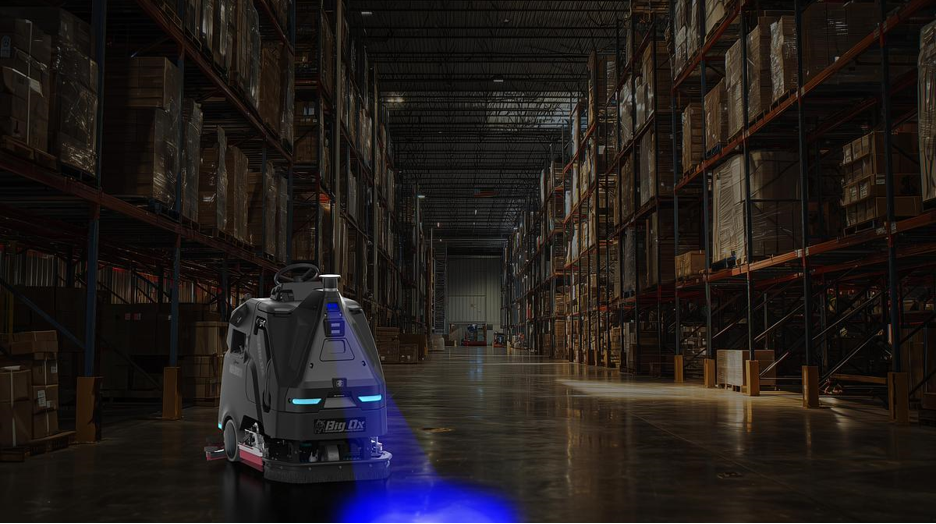
When companies start shopping for better floor cleaning equipment, two terms come up constantly: robotic floor scrubber and automatic floor scrubber machine. They sound interchangeable, but they’re not—and choosing the wrong one can mean wasted money, wasted labor, and floors that still don’t get cleaned the way they should.
Here’s a straightforward breakdown of what each type actually does, where they excel, and which one makes sense for your operation.
What Is a Robotic Floor Scrubber?
A robotic floor scrubber—also called an autonomous floor scrubber or industrial floor cleaning robot—is designed to clean with little to no human involvement. You program a cleaning route, and the machine handles the rest: navigating your facility, adapting to obstacles, and covering every square foot on its own.
These machines rely on advanced technology to get the job done:
-
LiDAR sensors and cameras for real-time navigation
-
Facility mapping that learns and optimizes cleaning routes over time
-
Obstacle detection that reroutes around pallets, forklifts, and foot traffic automatically
In a real-world warehouse setting, that means the machine moves through your facility without anyone steering it. It avoids equipment, works around people, and keeps cleaning.
More advanced robotic systems take it even further—they’ll return to a docking station on their own to recharge, refill water, or dump dirty water, then pick up right where they left off. Some units can run 13+ hours in a single cycle, making them ideal for overnight or around-the-clock cleaning.
What Is an Automatic Floor Scrubber Machine?
An automatic floor scrubber machine automates the scrubbing process itself—dispensing solution, scrubbing the floor, and vacuuming up dirty water in a single pass—but it still requires a human operator to drive it. Think of it as power-assisted cleaning rather than autonomous cleaning.
Automatic machines are commonly used in:
-
Smaller facilities where full autonomy isn’t necessary
-
Tight or complex layouts that benefit from human judgment
-
Operations where cleaning happens during active work hours with staff already on-site
They’re proven, reliable machines. But their performance is only as consistent as the person operating them—and they require that person to be available every time floors need cleaning.
Key Differences Between the Two
1. Level of Automation
This is the fundamental divide. A robotic floor scrubber operates independently—it replaces labor. An automatic floor scrubber machine assists labor—it still needs someone behind the wheel. If your goal is to reduce headcount on cleaning tasks, that distinction matters a lot.
2. Labor Requirements
Robotic systems can eliminate or drastically reduce the need for dedicated cleaning staff. Automatic machines still require an operator for every cleaning session. In facilities struggling with labor shortages or high turnover—which is most warehouses right now—this is often the deciding factor.
3. Cleaning Consistency
A robotic unit follows the same programmed route every single time. No corners cut, no areas skipped, no variation based on who’s working that shift. Operator-driven machines are subject to human inconsistency—fatigue, rushing, missed spots. For large facilities where documentation and compliance matter, the robotic advantage here is significant.
4. Large-Space Efficiency
An autonomous floor scrubber for warehouses is purpose-built for big footprints. These machines can cover massive areas over extended run times, returning to dock for water and charging as needed, then resuming automatically. Automatic machines can handle large areas too, but they’re limited by operator availability and shift schedules.
5. Obstacle Handling
Modern industrial floor cleaning robots use LiDAR and camera systems to detect obstacles in real time, dynamically adjust their path, and continue cleaning without stopping. With an automatic machine, obstacle avoidance is entirely on the operator—they see something in the way, they steer around it. That works fine until they don’t see it.
When a Robotic Floor Scrubber Makes Sense
A robotic solution is the right call when:
-
You manage a large warehouse, distribution center, or manufacturing floor
-
You want to reduce your dependence on cleaning labor
-
You need cleaning to happen overnight or outside of normal shifts
-
Consistent, repeatable results are a priority for safety or compliance
These machines are especially valuable in facilities where cleaning needs to happen without disrupting active operations.
When an Automatic Floor Scrubber Machine Is the Better Fit
An operator-driven machine may be the smarter choice when:
-
Your facility is smaller or has tight, complex layouts
-
You already have reliable staff available for cleaning duties
-
Cleaning is periodic rather than continuous
-
You need maximum flexibility to clean different areas on the fly
In these cases, the lower upfront cost and simplicity of an automatic machine can be the better value.
The Bottom Line
Both types of machines make floor cleaning faster and more effective than manual methods. But they solve different problems. A robotic floor scrubber is built for automation, consistency, and labor reduction in large-scale environments. An automatic floor scrubber machine is built for flexibility and operator control in smaller or more complex settings.
The right choice depends on your facility size, your workforce situation, and your long-term operational goals. If you’re not sure which direction makes sense, it’s worth talking to a dealer who knows both sides of the equation.
